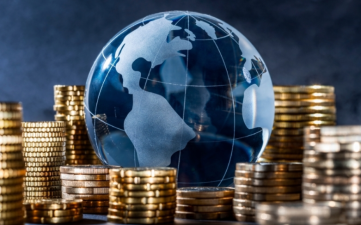
In the wave of economic globalization, the global economic landscape resembles a giant ship sailing on turbulent waves; even the slightest fluctuation can trigger a chain reaction, bringing enormous shocks. Currently, some predict a series of severe economic crises may erupt globally by 2025. This prediction casts a shadow, attracting widespread attention and deep reflection.The global economy is not expected to experience a full-blown crisis in 2025, but it will be in a state of "fragile resilience," characterized by slower growth, accumulating risks, and vulnerability to external shocks. This vulnerability stems from a confluence of pressures, including trade policy uncertainty, geopolitical tensions, potential risks from the development of artificial intelligence, and fiscal pressures.
Tariff threats cast a shadow over global trade
In its latest World Economic Outlook report released on October 14, the IMF pointed out that the repeated escalation of tariffs and trade barriers is becoming the primary risk to global economic recovery.
Trade conflicts intensify. Since the beginning of this year, Trump has continuously raised tariff barriers, undermining the free trade system and triggering a chain reaction. Many countries around the world have successively introduced protectionist policies, and international trade tensions have continued to escalate.
Although the United States has reached trade agreements with many countries, the uncertainty of the Trump administration's policies makes the global trade tension situation still far from optimistic.
Faced with the escalating trade war, the IMF and delegations from multiple countries warned that if major economies continue to pursue economic competition unilaterally, the fragmentation of global supply chains and inflationary pressures may further intensify, leading to a new round of structural shocks to the global economy.
Negative Effects Emerging
Although most economic data has exceeded expectations over the past six months, with the S&P 500 index rising by 30% since its April lows, Harvard University economics professor Karen Dinan pointed out at a symposium accompanying the annual meeting: "The current resilience of trade is encouraging but unsustainable. Businesses are depleting their inventory and upfront purchasing buffers, and a global economic slowdown next year is inevitable."
AI Bubble Brings Concerns about the Digital Golden Age
Artificial intelligence (AI), as a technological representative of the next generation of industrial revolution, presents a significant opportunity for global economic transformation and upgrading with its investment boom. However, at this annual meeting, the IMF also issued a strong warning about the potential risks of the AI investment boom.
In 2025, global venture capital firms invested $192.7 billion in AI startups, accounting for more than half of the total global venture capital investment. However, the commercial application of AI technology is still in its early stages, and most companies have not yet established a stable profit model.
Independent research firm Micro Strategy believes that the loose interest rate environment has led to a massive influx of capital into the artificial intelligence field. However, the AI industry still faces significant technological bottlenecks, including high training costs, weak differentiation between models, and a lack of sustainable profitability. These problems have resulted in a large amount of capital flowing into high-cost projects with uncertain returns.
How Ordinary People Should Cope with an Economic Crisis
Faced with a potential economic crisis, "preparation is key."
Instead of panicking, take action and make the following preparations to cope calmly during the "winter":
- Reduce spending and increase savings: Control your consumption desires, avoid unnecessary spending, and use more funds for savings to cope with future uncertainties.
- Cash is king, invest cautiously: During an economic crisis, cash is the safest asset. 1. Avoid high-risk investments and invest in low-risk, highly liquid financial products.
- Clear debts and start fresh: Repay high-interest debts as soon as possible to reduce cash flow pressure and avoid financial distress.
- Secure stable employment and improve skills: Having stable employment is crucial during an economic crisis. At the same time, continuously improve your skills to enhance your competitiveness in the workplace.
- Prepare emergency funds: Set aside 3-6 months' worth of living expenses as emergency funds to cope with unforeseen circumstances.
- Keep learning and seek opportunities: Economic crises are also a time of both opportunities and challenges. Keep learning, pay attention to market dynamics, and seek potential investment opportunities.
The global economy faces many severe challenges in 2025. The potential crises in the United States, Japan, and the European Union are intertwined, forming a complex and fragile global economic landscape. However, as the philosophy of "no destruction, no construction" suggests, while economic crises bring destruction, they may also become an opportunity to promote global economic restructuring and reform. Governments, businesses, and investors worldwide should remain highly vigilant, closely monitor economic developments, and proactively take measures to address potential crises, mitigate their impact, and seek new development opportunities within them. Only in this way can the global economy emerge from the storm and embark on a healthier, more stable, and sustainable development path.